This report provides an exhaustive analysis of the VRE platform, examining its functional capabilities, technical underpinnings, and the strategic implications of its deployment across diverse institutional sectors.
The Evolution of the Digital Event Ecosystem
The transition from physical to virtual convening was initially driven by necessity, but the sustained viability of platforms like VRE suggests a fundamental shift in the valuation of digital interaction. The Virtual Real Event platform distinguishes itself by focusing on “functional immersion”?—?a concept where the depth of engagement and social connectivity compensates for the lack of physical presence.
While the platform’s nomenclature suggests a “Virtual Real” experience, it is critical to note that the current technological manifestation does not explicitly rely on peripheral hardware such as VR headsets, Oculus, or HTC devices. Instead, the immersion is achieved through a 100% live interactive environment that claims to generate five times higher engagement than standard virtual event configurations.
This engagement metric is not merely a statistical claim but reflects a psychological shift in attendee behavior. In traditional webinars, participants are often relegated to the role of passive observers, a state that leads to rapid cognitive fatigue and attrition. VRE counteracts this through a suite of tools designed to maintain high levels of active participation. The architecture facilitates a transition from a spectator model to a participant model, where the attendee is constantly integrated into the session flow through live polls, real-time Q&A, and collaborative workshops.
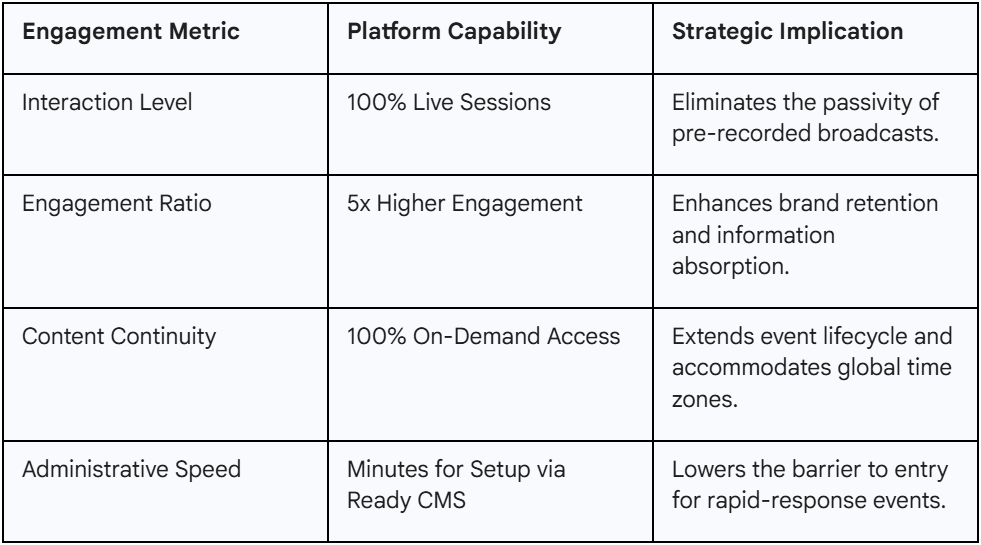
The readiness of the platform is further exemplified by its Content Management System (CMS), which allows for the rapid deployment of virtual environments. This speed-to-market is a critical factor for organizations operating in volatile environments where information must be disseminated quickly. The CMS serves as the foundational layer upon which the various engagement modules?—?ranging from ticketing and payments to AI-matchmaking?—?are integrated.
Core Architecture of Attendee Engagement
The primary objective of the VRE platform is to replicate and enhance the interactive quality of in-person gatherings. This is achieved through a multi-layered engagement strategy that prioritizes real-time bidirectional communication. The platform’s webinars and sessions are not static streams but are described as fully interactive environments where the audience can influence the direction of the discourse.
Real-Time Interactivity and Feedback Loops
The integration of live polls and Q&A sessions creates immediate feedback loops between the speaker and the audience. These tools serve a dual purpose: they provide the speaker with real-time data on audience sentiment and ensure that the content remains relevant to the participants’ needs. From a pedagogical perspective, the use of real-time collaboration tools in workshops and breakout rooms is significant. These environments allow for peer-to-peer learning, which is often lost in digital formats.
The mechanism of engagement is further supported by the platform’s support for live video and real-time collaboration tools. This technical specification ensures that the high-touch nature of workshops?—?where participants may need to co-create or brainstorm?—?is maintained. By providing the infrastructure for breakout rooms, VRE enables organizers to segment large audiences into smaller, more manageable groups where meaningful interaction is more likely to occur.
The Psychology of Gamification
To sustain engagement over long durations, VRE incorporates more than ten specialized engagement tools rooted in behavioral psychology. These include leaderboards, challenges, badges, and point systems. The strategic application of gamification serves to anchor attendee attention by providing incremental rewards for participation.
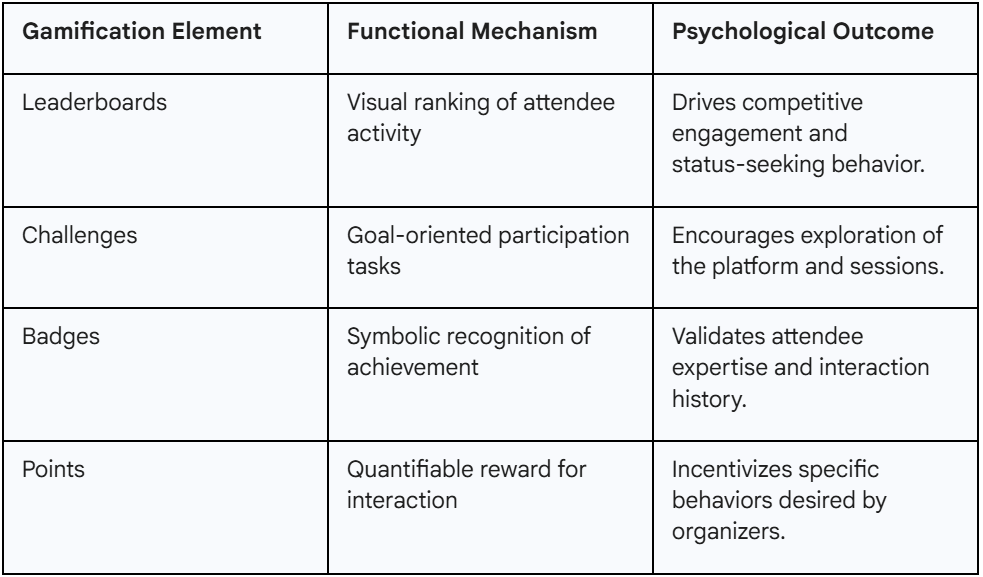
The personalization of session recommendations further enhances this psychological anchoring. By utilizing attendee data to suggest relevant content, the platform reduces the “choice overload” that often leads to disengagement in large-scale events. This personalized approach ensures that the attendee feels the event is tailored to their specific professional interests and career trajectory.
Advanced Social Dynamics and AI-Driven Networking
One of the most persistent criticisms of virtual events is the lack of “serendipitous networking”?—?the spontaneous connections that occur in the physical lobbies of conference centers. The VRE platform addresses this through a sophisticated social engineering layer that utilizes AI-powered matchmaking to facilitate 1:1 meetings and discussion tables.
AI-Powered Matchmaking Algorithms
The matchmaking algorithm functions as a digital curator, analyzing attendee profiles and interests to suggest high-value pairings. This technology moves beyond the random networking models used by earlier platforms, ensuring that the time spent in 1:1 meetings is productive and aligned with the participants’ professional goals. This is particularly critical for B2B networking events and trade shows where the primary ROI for attendees is the acquisition of new business contacts.
The social infrastructure is expanded by the inclusion of over 50 themed virtual lounges and speed networking sessions.1 These lounges provide a structured yet flexible environment for informal discussion, allowing organizers to create spaces dedicated to specific topics, industries, or interest groups. By providing a diverse range of social environments, VRE accommodates different networking styles, from the structured intensity of speed networking to the more relaxed atmosphere of themed lounges.
The Virtual Lounge Ecosystem
The lounges serve as persistent social hubs that remain active throughout the event duration. These spaces are critical for fostering a sense of community among participants. In a digital context, the presence of themed lounges helps to mitigate the isolation often felt by remote attendees. By creating a visual and functional space for “discussion tables,” the platform encourages small-group interactions that can lead to deeper professional relationships than those formed in large-scale broadcast sessions.
The Lifecycle of Content and On-Demand Sustainability
The value of an event is often limited by its duration; however, VRE extends this value through a comprehensive on-demand strategy. The platform ensures that 100% of the live sessions are recorded and remain accessible post-event.1 This archival capability transforms the event from a fleeting moment into a persistent knowledge repository.
Content Recording and Archival Strategy
The transition of live sessions into on-demand content is a seamless process within the VRE architecture. This approach is particularly beneficial for global events where attendees in different time zones may not be able to participate live. It also provides a valuable resource for attendees who wish to revisit complex technical workshops or panel discussions. The sustainability of the content ensures that the initial investment in producing the event continues to yield returns long after the live broadcast has concluded.
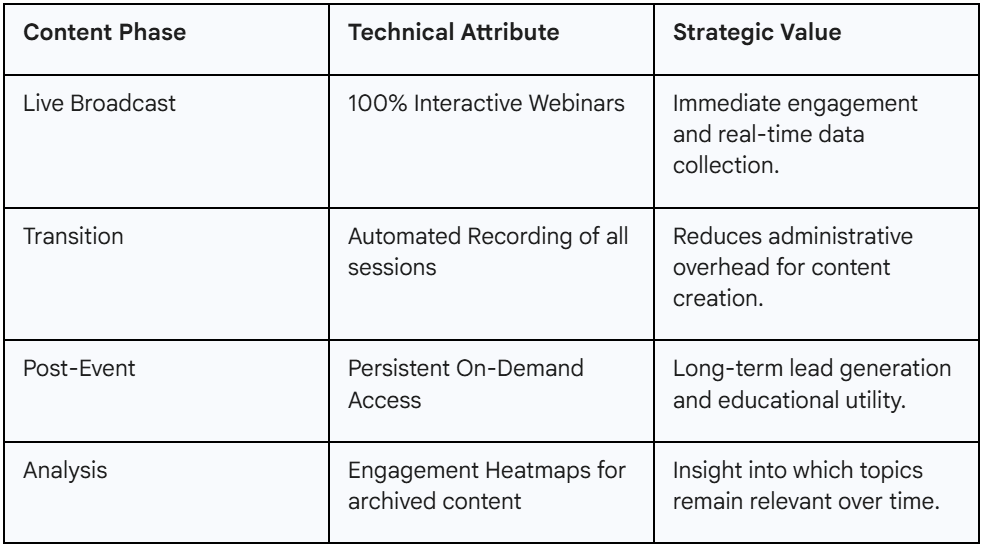
The integration of post-event reports and engagement heatmaps for recorded content allows organizers to track the “long-tail” of their event’s impact. By understanding which sessions are viewed most frequently after the event, organizers can better align their future content strategies with audience demand.
Data Intelligence: Actionable Insights and Behavioral Analytics
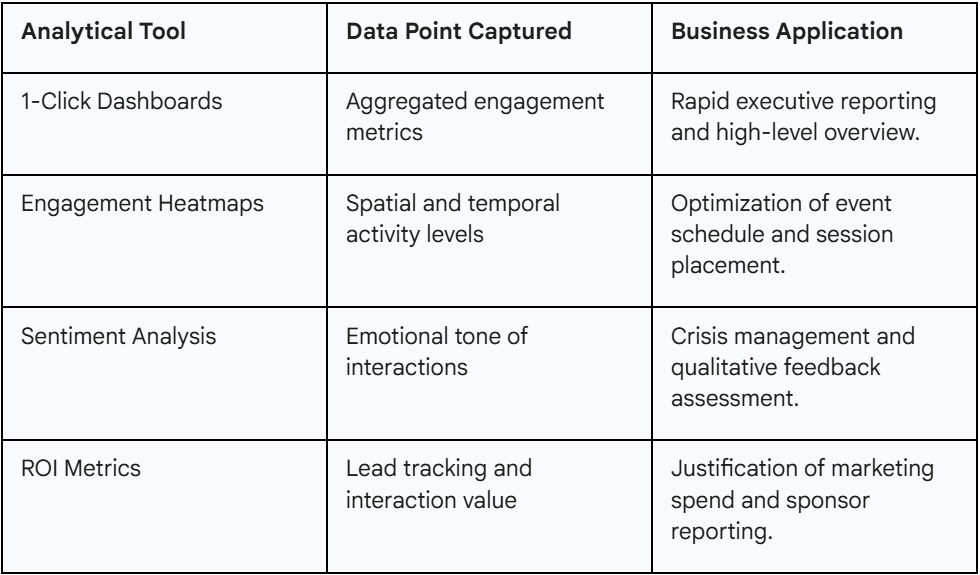
The Virtual Real Event platform provides a robust analytical framework that goes far beyond simple attendance metrics. Through 1-click dashboards, organizers can access engagement heatmaps, sentiment analysis, and comprehensive post-event reports. This data-driven approach allows for the quantification of event success and the calculation of precise ROI.
Engagement Heatmaps and Participant Tracking
Engagement heatmaps provide a visual representation of attendee activity across the platform. This data indicates which sessions, speakers, or virtual lounges were most successful in capturing and retaining attention. By analyzing these heatmaps, organizers can identify “dead zones” where engagement dropped and “hot spots” where interaction was highest. This information is invaluable for refining the event flow in future iterations.
The tracking of interactions extends to leads and ROI metrics.For marketing and sales-focused events, the ability to track exactly how an attendee interacted with a product demo or a virtual booth provides a direct link between the event and the sales funnel. This level of granularity is rarely achievable in physical events, where attendee movement is much harder to quantify.
Sentiment Analysis and Qualitative Data
A unique feature of the VRE analytical suite is sentiment analysis. By utilizing natural language processing to analyze chat logs, Q&A submissions, and social interactions, the platform can gauge the overall emotional tone of the event. This qualitative layer provides context to the quantitative engagement metrics. For example, high interaction levels in a Q&A session might be interpreted as positive engagement, but sentiment analysis could reveal that the interaction was driven by confusion or dissatisfaction. Understanding these nuances allows organizers to address issues in real-time or adapt their communication strategies post-event.
Operational Infrastructure and Administrative Control
The administrative efficiency of the VRE platform is a key differentiator, particularly for organizations that manage high-frequency events. The “Ready CMS” is designed for ease of use, enabling the setup of complex virtual environments in minutes.1 This efficiency does not come at the expense of control, as the platform includes integrated systems for ticketing, payments, and role-based access.
Integrated Ticketing and Tiered Payments
VRE simplifies the financial logistics of event management by providing integrated ticketing and payment systems. These systems support tiered options, allowing organizers to create multiple access levels?—?such as general admission, VIP, or early-bird pricing?—?within a single event.1 This integration ensures a frictionless registration process for attendees and provides organizers with real-time data on revenue and registration rates.
The technical specifications of the payment system are designed for security and compliance, ensuring that financial transactions are handled according to international standards. This is a critical requirement for global events that must process payments across different jurisdictions and currencies.
Security, Governance, and Regulatory Compliance
In an era of increasing data scrutiny, the security profile of a virtual event platform is a primary consideration for enterprise clients. VRE is 100% secure and fully GDPR-compliant, ensuring that attendee data is handled with the highest level of care.1 This compliance is essential for organizations operating in the European Union or those that collect data from EU citizens.
The platform utilizes role-based access control to manage participant permissions. This ensures that only authorized individuals can access specific areas of the event, such as administrative dashboards, speaker green rooms, or high-level executive sessions.1 This granular control is vital for maintaining the integrity of the event and protecting sensitive information.
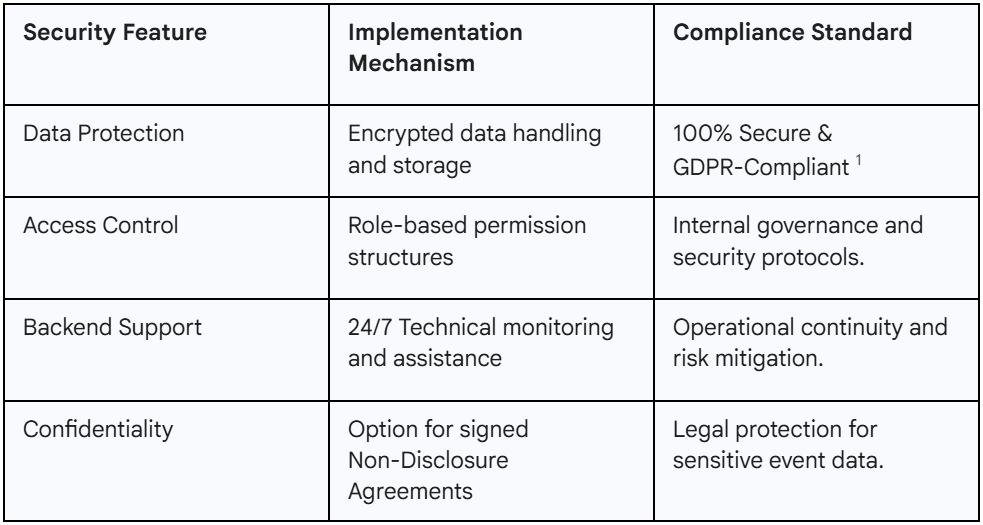
To further bolster confidence, VRE offers the option for signed Non-Disclosure Agreements (NDAs) during the demo and setup process. This indicates a focus on high-stakes corporate and government events where confidentiality is a non-negotiable requirement.
Sector-Specific Strategic Applications
The versatility of the Virtual Real Event platform is demonstrated by its application across a wide spectrum of industries. While the platform provides a core set of features, the strategic application of these tools varies significantly depending on the sector’s specific needs.
Corporate and Business Operations
In the corporate sector, VRE is utilized for a range of internal and external functions. Annual General Meetings (AGMs) and investor/shareholder meetings benefit from the platform’s security and role-based access, ensuring that only verified stakeholders can participate in sensitive votes or discussions. For sales and marketing teams, product launches and sales kickoffs leverage the gamification and engagement tools to build momentum and align global teams.
Corporate training and development represent another significant use case. The platform’s support for collaborative workshops and breakout rooms allows for the delivery of standardized training programs to a geographically dispersed workforce. The on-demand recording feature ensures that this training remains accessible for onboarding new employees or for refresher courses.
Healthcare and Pharmaceutical Industry
The healthcare sector has unique requirements for education and communication, often governed by strict regulatory frameworks. Medical conferences and Continuing Medical Education (CME) programs utilize VRE to provide doctors and healthcare professionals with the latest clinical data.1The platform’s ability to host secure, moderated webinars and workshops is essential for pharma product launches and doctor/patient education sessions.
In the pharmaceutical industry, the high degree of interactivity offered by VRE is particularly valuable for virtual health camps and researcher symposiums. The sentiment analysis tool can be used to gauge the medical community’s reaction to new data or product announcements, providing pharmaceutical companies with critical market intelligence.
Education and Research Institutions
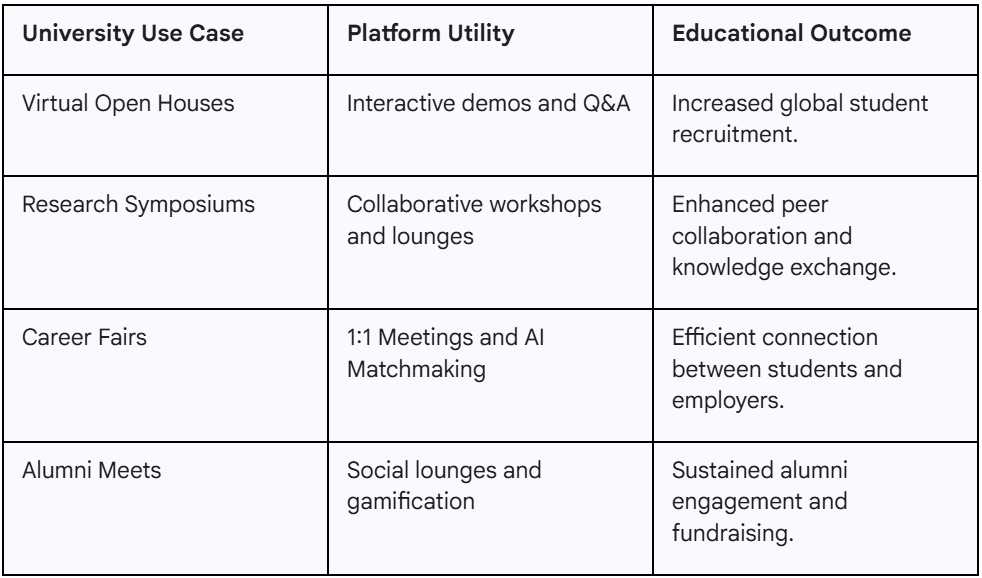
Universities and educational institutions use VRE to extend their reach beyond the physical campus. Virtual open houses and admission events allow institutions to attract students from across the globe, while student and faculty conferences facilitate the exchange of research.1 The platform’s ability to handle large audiences?—?over 1,000 participants?—?makes it suitable for university-wide events and global research summits.
Government and the Public Sector
For government agencies, VRE provides a platform for town halls, policy launches, and public consultations. These events require high levels of accessibility and security, both of which are core components of the VRE architecture. E-governance workshops and citizen awareness programs can be delivered at scale, with the platform’s analytics providing data on public engagement and sentiment regarding new policies.
Non-Profit and Social Organizations
Non-profits and NGOs utilize VRE for charity fundraisers, volunteer onboarding, and awareness campaigns. The gamification tools?—?such as leaderboards and challenges?—?are particularly effective in a fundraising context, where they can be used to incentivize donations and social sharing. Virtual awareness campaigns benefit from the platform’s ability to host immersive, high-engagement content that can be easily shared across social networks.
Logistics of Deployment: Procurement and Support
The process of implementing the Virtual Real Event platform is designed to be as frictionless as the event experience itself. Prospective clients are encouraged to schedule a personalized demo to explore the platform’s capabilities and see how specific use cases can be addressed.1
The Demo and Onboarding Process
The request for a demo requires the provision of specific information, including the event type of interest (Webinars, Conferences, Training, or Networking) and the estimated audience size. The platform categorizes audience sizes into several tiers: 1–100, 101–500, 500–1000, and 1,000+, indicating a highly scalable architecture.
The demo process is not merely a sales presentation but a collaborative planning session where the VRE team helps the client identify the best templates and features for their specific goals. The provision of a signed NDA with the demo confirmation ensures that the client’s event concepts and proprietary data remain protected from the outset.
Backend Support and Operational Stability
One of the most critical technical specifications listed is the 24/7 backend technical support. For live events, the risk of technical failure is a significant concern. The availability of constant technical assistance ensures that any issues can be addressed in real-time, minimizing disruption to the event flow. This support extends from the initial setup and CMS configuration to the live execution and post-event data extraction.
The administrative contact for inquiries and feedback is provided through dedicated email and phone channels, ensuring that organizers have a direct line to the technical and management teams. This high level of support is essential for maintaining the “100% secure” and “100% live” promise of the platform.
The Paradox of Immersive Realism without Hardware Intervention
An interesting finding from the analysis of the Virtual Real Event platform is the absence of traditional “immersive” technologies such as VR, AR, 3D avatars, or headset compatibility. Despite its name and its position as an “Immersive Event Platform,” VRE achieves its immersion through a different mechanism: psychological and social density.
Functional Immersion vs. Visual Realism
In many virtual platforms, the focus is on creating a 3D visual representation of a conference center. While visually impressive, these environments often lack the functional depth required for meaningful professional interaction. VRE reverses this priority. By focusing on 100% live interaction, AI matchmaking, and deep gamification, the platform creates an environment where the participant is so actively involved that the lack of a 3D avatar becomes irrelevant.
This “functional immersion” is a more accessible and scalable model for the enterprise. It does not require attendees to own or learn how to use specialized hardware, and it does not demand the high bandwidth often required for 3D environments. By optimizing for standard web and mobile accessibility while maximizing interactivity, VRE ensures the widest possible reach for its clients.
Future Outlook and Technological Scalability
The current architecture of VRE is well-positioned for future expansion. The modular nature of its features?—?integrated into a Ready CMS?—?allows for the incremental addition of new technologies as they become viable for the mass market. While 3D and VR are not currently highlighted, the platform’s commitment to “immersive events” suggests that these could be integrated as the technology matures and becomes more accessible to the target industries.
The ongoing development of AI matchmaking and sentiment analysis will likely remain a core focus, as these features provide the greatest differentiation and value in the professional event space. As the platform’s data set grows, the predictive capabilities of its AI will improve, leading to even more precise matchmaking and more insightful session recommendations.
Strategic Synthesis and Recommendations
The Virtual Real Event platform represents a sophisticated solution for the modern convening needs of diverse organizations. By prioritizing engagement, networking, and data intelligence over visual gimmicks, it provides a functional and scalable environment for high-stakes digital interaction.
Actionable Strategic Insights for Event Organizers
Organizers looking to maximize their event impact should focus on the following core strengths of the VRE platform:
- Leverage the Multi-Tiered Engagement Suite: Do not rely on static webinars. Utilize the workshops, breakout rooms, and live collaboration tools to create a bidirectional flow of information.
- Prioritize AI Networking: Encourage attendees to complete detailed profiles to maximize the efficacy of the AI-powered matchmaking. This is the primary driver of professional ROI for many participants.
- Implement Comprehensive Gamification: Use the point systems and leaderboards to drive participation in key sessions and interactions with sponsors.
- Utilize the Full Spectrum of Analytics: The 1-click dashboard and sentiment analysis should be used not just for post-event reporting but for real-time adjustments during multi-day events.
- Capitalize on Content Continuity: Develop a strategy for the on-demand phase of the event. Use the recorded sessions as part of a long-term content marketing and lead generation strategy.
The analysis of the Virtual Real Event platform underscores the importance of a holistic approach to virtual convening. In an environment where digital attention is a scarce commodity, the platform’s focus on interactivity and social connectivity provides a clear path forward for organizations that need to convene, educate, and engage their stakeholders at scale. The integration of robust administrative tools and clear security protocols ensures that this engagement can happen within a framework of safety and professional integrity.
Works cited
Virtual Real Event: Best Virtual Event Platform for Immersive Events, accessed on January 6, 2026, https://virtualrealevent.com/features
Comments