Corn has a way of showing up everywhere?—?and nowhere is that truer than in India, where it’s loved by millions but genuinely understood by very few. Corn is especially popular across North India, but most people know it only as a grain, not as the centuries-old food tradition it actually is.
Because corn?—?or maize?—?is so much more than a grain. It’s one of the oldest cultivated foods on the planet, feeding civilisations for thousands of years before it ever reached Indian soil.
Scientific evidence suggests maize domestication began in southwestern Mexico roughly 9,000 years ago, when indigenous communities slowly turned wild teosinte into the grain we recognise today. From there, maize travelled through North and South America, weaving itself into local food, agriculture, and culture along the way.
After Europeans arrived in the Americas, maize made its way to Europe, and traders carried it onward through Africa and Asia during the 16th and 17th centuries. Its high yields, versatility, and adaptability made it a global staple almost overnight.
But here’s the catch: the grain travelled. One of its most valuable traditions didn’t always come with it?—?nixtamalisation.
What is Masa Harina? The forgotten wisdom behind it
So, what is masa harina, exactly? It isn’t just “corn flour with a fancy name.” Masa harina is dried maize that has gone through nixtamalisation?—?an ancient alkaline process indigenous Mesoamerican communities have used for centuries.
The word itself comes from Nahuatl: nextli (ashes) and tamalli (prepared corn dough).
Here’s how the traditional process works, step by step:
Whole dried maize is gently cooked in water with food-grade lime (calcium hydroxide).
It’s left to soak so the alkaline solution can fully penetrate the kernels.
The corn is washed thoroughly to remove the loosened outer skin (the pericarp).
It’s ground into a soft, sweet-smelling dough called masa.
That dough is carefully dried and milled to create masa harina?—?nixtamalized corn flour.
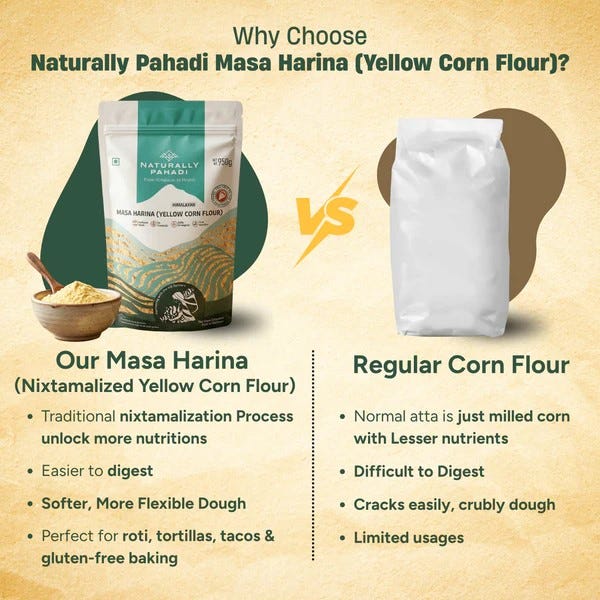
This is exactly what separates masa harina from ordinary corn flour or makki atta. Masa harina isn’t maize that’s simply been dried and pulverised?—?it’s maize that’s been fundamentally transformed, with better nutrition, aroma, texture, and cooking performance to show for it.
What is nixtamalized corn flour, and why does it matter?
If you’re wondering what nixtamalized corn flour actually is beyond the process itself?—?it’s the flour left behind once maize has been through that alkaline treatment, dried, and milled. It behaves differently in the kitchen, tastes different, and?—?most importantly?—?digests differently in the body.
What was lost when corn travelled without its tradition
As maize spread far beyond Mesoamerica, it was often ground and cooked without nixtamalisation. That one missing step turned out to matter a lot more than anyone realised at the time.
Untreated maize contains niacin (vitamin B3), but in a form the human body can’t easily absorb. It’s also naturally low in two essential amino acids?—?lysine and tryptophan. In communities that relied heavily on untreated maize with limited dietary variety, niacin deficiency led to pellagra, a serious nutritional disease.
To be clear, nixtamalisation doesn’t turn maize into a “complete” food, and it’s no substitute for a well-rounded diet. But it does make several of the grain’s nutrients significantly more available to the body?—?niacin becomes more accessible, calcium gets absorbed from the food-grade lime, and phytic acid (an antinutrient that binds certain minerals) may be reduced.
Naturally Pahadi Masa Harina: made with Himalayan corn
Naturally Pahadi brings together two remarkable food traditions?—?the ancient wisdom of Mesoamerica and the agricultural heritage of the Indian Himalayas.
Our masa harina is made from Himalayan maize grown at high elevations in Chakrata, Uttarakhand. The corn is cultivated by local mountain farming communities, carefully sourced, and traditionally nixtamalised before being dried and milled into a versatile, aromatic flour.
The result is a beautiful, easy-to-work-with flour that connects Mesoamerican processing knowledge with Himalayan mountain agriculture?—?genuinely one of the more interesting food stories you’ll come across.
Is Masa Harina gluten free?
Yes?—?masa harina is naturally gluten free, since it’s made entirely from corn with no wheat involved. This makes it a solid option if you’re looking for gluten free corn flour online, whether you’re managing gluten sensitivity or simply prefer to cook without wheat-based flours. As always, if you’re buying packaged masa harina, it’s worth double-checking the label for cross-contamination disclosures, especially if you have coeliac disease.
Nutritional benefits of corn
Corn’s nutritional profile shifts a bit depending on the variety, growing conditions, and how it’s processed?—?but broadly, it offers:
Complex carbohydrates?—?steady energy for everyday activity and satisfying meals
Dietary fibre?—?whole-grain corn supports digestion and helps you feel fuller for longer
Plant-based protein?—?a modest protein contribution, best paired with pulses, dairy, eggs, or nuts for a fuller amino-acid profile
B vitamins?—?several B-group vitamins that play a role in normal energy metabolism
Essential minerals?—?naturally occurring magnesium and phosphorus, along with smaller amounts of other micronutrients
Natural plant compounds?—?coloured corn varieties may carry carotenoids, phenolic compounds, and other antioxidants
Key benefits of nixtamalisation
A lot of what makes masa harina special comes down to how it’s made, not just what it’s made from.
Improves niacin bioavailability?—?alkaline processing helps release bound niacin, making vitamin B3 more accessible
Increases calcium content?—?calcium from the food-grade lime moves into the kernels during soaking. Research has shown meaningful increases in calcium after nixtamalisation, though the exact amount depends on the method used (study on extrusion and nixtamalisation)
Reduces certain antinutrients?—?phytic acid, which can bind minerals like calcium, iron, and zinc, is often lowered
Supports protein digestibility?—?the alkaline treatment reshapes the grain’s protein structure, potentially improving digestibility
Makes the grain easier to process?—?the outer pericarp loosens and kernels soften, making them easier to grind into a smooth, cohesive dough
Creates pliable dough?—?unlike regular cornmeal, masa harina forms a dough that actually binds together, which is exactly why it works so well for soft tortillas, rotis, tacos, wraps, and more
Develops a distinctive aroma?—?that warm, roasted, slightly earthy fragrance you associate with authentic masa comes directly from the alkaline cooking process
Enhances flavour?—?nixtamalisation softens the raw, starchy taste of untreated corn and brings out a richer, deeper flavour. Studies on traditional tortillas point to aroma, subtle lime notes, and overall sensory character as key markers of authentic nixtamalised products (research on traditional tortilla flavour)
Improves texture?—?the treated starch and proteins result in preparations that are softer, more flexible, and less crumbly than those made from ordinary corn flour
May reduce certain mycotoxins?—?washing, alkaline cooking, and removing the outer layers can lower some naturally occurring fungal toxins, though the extent varies by contaminant and processing conditions. Nixtamalisation should complement, not replace, good agricultural, storage, and food-safety practices (research on mycotoxin reduction)
Supports better keeping quality?—?once properly dried and packed, nixtamalised flour stores well. Drying reduces moisture-related spoilage risk, while good packaging protects aroma and quality (shelf life still depends on moisture, temperature, hygiene, and packaging)
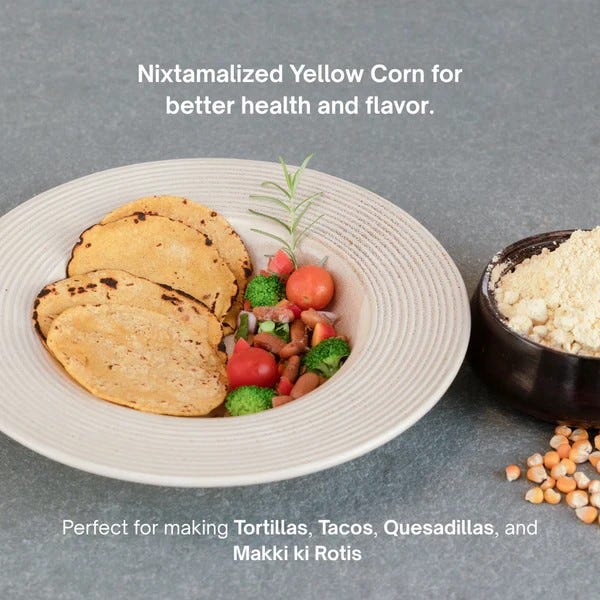
Offers remarkable cooking versatility?—?tortillas, tacos, quesadillas, enchiladas, tamales, chips, flatbreads, and even Indian-style rotis, theplas, and fusion snacks
Masa Harina vs corn flour: what’s the real difference?
This is probably the most common question we get, so let’s settle it clearly.
Regular corn flour (or makki atta) is just dried corn, ground down?—?no nixtamalisation involved. Masa harina goes through that entire alkaline cooking, soaking, and washing process first. That difference shows up in three ways:
Texture?—?masa harina forms a pliable, cohesive dough; plain corn flour tends to crumble
Flavour and aroma?—?masa harina has that distinctive roasted, earthy, faintly limey character that plain corn flour simply doesn’t develop
If you’re comparing white corn flour benefits against masa harina specifically, it’s worth knowing that white corn masa harina tends to have a milder, slightly sweeter flavour than yellow corn versions?—?which makes it a popular choice for soft tortillas and delicately flavoured dishes.
How to use Masa Harina in your kitchen
Masa harina is far more flexible than most people expect. Here’s how to put it to work:
For dough: Mix masa harina with warm water in roughly a 1:1 ratio (adjust as needed) until it forms a soft, pliable dough that doesn’t crack at the edges when pressed.
For tortillas: Divide the dough into small balls, press them flat (a tortilla press works best, but a rolling pin does the job too), and cook on a hot, dry skillet for about 30–60 seconds per side.
For tamales: Use the dough as a base, spread it onto corn husks, add your filling, and steam.
For thickening: A spoonful of masa harina can thicken soups, stews, and sauces, adding subtle corn flavour along the way.
For Indian-style flatbreads: Blend masa harina with your regular atta, or use it on its own for a corn-forward roti or thepla.
Homemade tortillas with Masa Harina?—?the basics
Making homemade tortillas with masa harina at home is simpler than it looks:
Combine masa harina with warm water and a pinch of salt, and knead until smooth.
Rest the dough for about 15–20 minutes, covered, so it hydrates fully.
Divide into equal balls and press each one flat between two sheets of plastic (or use a tortilla press).
Cook on a hot, ungreased skillet until lightly speckled on both sides.
That’s genuinely it?—?no yeast, no proofing, no complicated technique. Just good masa harina and a hot pan.
Masa Harina for tortillas: what makes a good one?
If tortillas are your main reason for buying masa harina, a few things are worth looking for:
Fine, even grind?—?for a smooth, workable dough
Fresh aroma?—?that roasted, earthy smell is a good sign of quality nixtamalisation
Minimal additives?—?ideally just corn and food-grade lime, nothing else
Good hydration behaviour?—?it should form a dough that holds together without cracking
Where to buy Masa Harina in India
Finding authentic masa harina in India used to mean scouring specialty import stores or paying steep shipping costs for imported bags. That’s changed. If you’re looking to buy masa harina online, Naturally Pahadi offers an option that’s both authentic in process and genuinely local in sourcing?—?nixtamalized corn flour made from Himalayan maize, grown and processed right here.
Whether you’re searching for the best masa harina in India, looking to buy white corn masa harina specifically, or simply want Mexican corn flour online without importing it from abroad, choosing a product that’s traditionally nixtamalised (not just labelled “corn flour”) makes a real difference in how it cooks and tastes.
A few things worth checking before you buy masa harina online:
Confirm it’s genuinely nixtamalized corn flour, not just finely ground cornmeal
Look for clear sourcing information (where the corn is grown, how it’s processed)
Check for freshness and proper airtight packaging
If gluten free corn flour online is your priority, verify there’s no cross-contamination risk
Ancient technique, modern relevance
Nixtamalisation is a powerful reminder that traditional food processing was rarely accidental?—?it was grounded in careful observation and generations of practical wisdom. Long before modern nutrition science could explain bioavailability or antinutrients, indigenous communities had already figured out how to make maize more nutritious, more flavourful, and more useful.
Naturally Pahadi Masa Harina revives that knowledge using maize grown in the upper Himalayan heights of Chakrata. It’s not just any maize flour?—?it’s premium masa harina, authentic masa harina flour that’s been carefully transformed for better functionality, a genuinely unique aroma, and a taste that feels both traditional and new.
Ancient Mesoamerican wisdom + Himalayan-grown maize + the convenience of today. All in one nourishing flour.
Comments