Market Overview
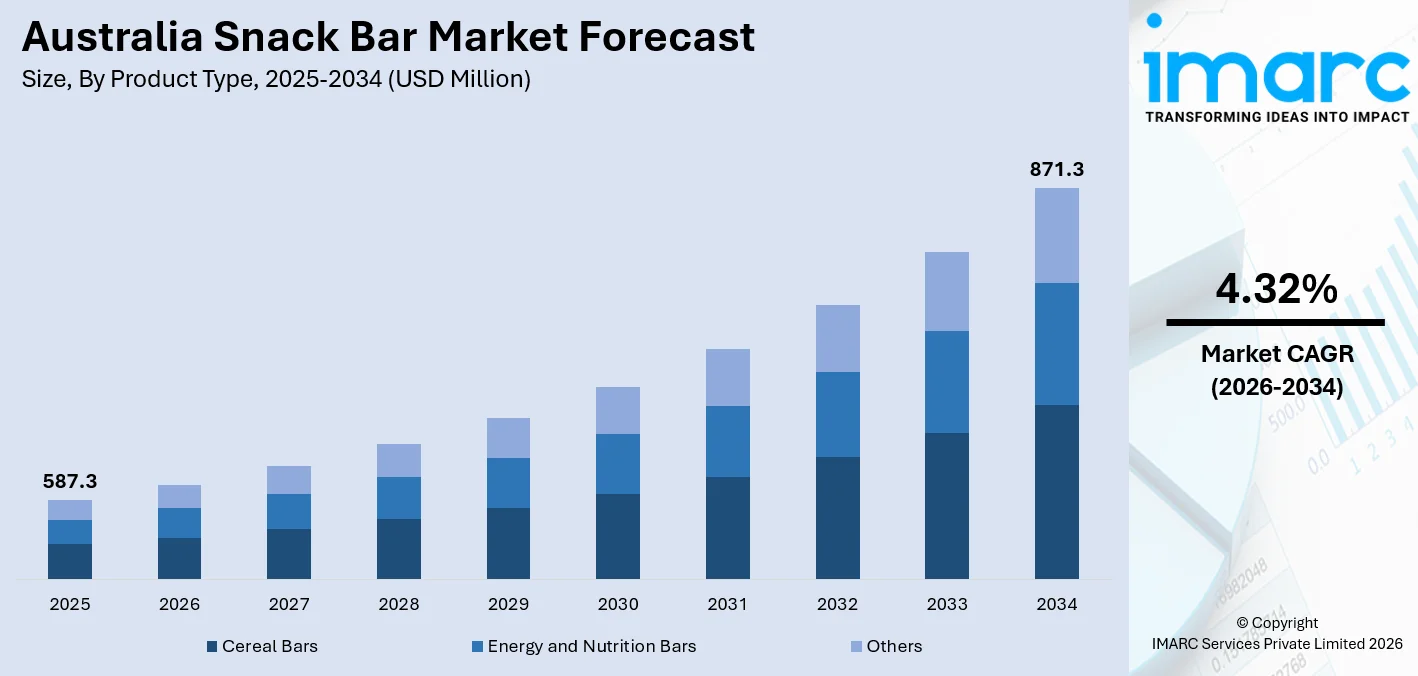
The Australia snack bar market is witnessing steady growth driven by busy lifestyles, increasing demand for convenient and healthy on?the?go snacks, rising health consciousness, and product innovation in protein, energy, and nutritional bars. The market size was valued at USD 587.3 Million in 2025 and is projected to reach USD 871.3 Million by 2034, growing at a compound annual growth rate (CAGR) of 4.32% from 2026?2034.
This market is strategically important to Australia’s food and beverage economy, supporting the shift toward functional and better?for?you snacking options. The snack bar market in Australia is growing steadily, driven by busy lifestyles and demand for convenient, healthy snacks. Energy and nutrition bars consist of nutrients including carbohydrates, vitamins and minerals thus helping in providing energy to consumers, while protein bars are increasingly popular among fitness enthusiasts and health?conscious individuals.
The Australia snack bar market is poised for sustained expansion, driven by health and wellness trends, on?the?go consumption patterns, and product innovation. With a projected CAGR of 4.32% through 2034, the market presents significant opportunities for manufacturers focusing on protein bars, functional ingredients, and clean?label formulations.
AUSTRALIA SNACK BAR MARKET SUMMARY
- The Australia snack bar market encompasses a range of products including protein bars, energy bars, nutritional bars, granola bars, and other snack bars, formulated to provide convenient, portable nutrition for health?conscious consumers.
- The ecosystem spans domestic and international snack bar manufacturers, ingredient suppliers, retail distribution networks, and e?commerce platforms.
- Major segments identified in the snack bar industry include product type (protein bars, energy bars, nutritional bars, granola bars, others), ingredient (nuts and seeds, grains, fruits, chocolate, protein isolates, others), distribution channel (supermarkets and hypermarkets, convenience stores, online, others), and region (Australia Capital Territory & New South Wales, Victoria & Tasmania, Queensland, Northern Territory & Southern Australia, Western Australia).
- Key trends shaping the market include rising demand for protein?rich and functional snack bars, clean?label and natural ingredient preferences, and expansion of online retail channels.
- Energy and nutrition bars are leading the market as they consist of nutrients including carbohydrates, vitamins and minerals helping in providing energy to consumers.
PORTER'S FIVE FORCES ANALYSIS – AUSTRALIA SNACK BAR MARKET
The competitive dynamics of the Australia snack bar market can be analysed using Porter's Five Forces framework.
Bargaining Power of Suppliers – Moderate
- Snack bar manufacturers rely on suppliers of nuts, seeds, grains, protein isolates, and chocolate ingredients. Australia’s established agricultural sector provides multiple sourcing options for many ingredients. However, the demand for specialised protein isolates and organic ingredients gives suppliers of premium raw materials moderate leverage.
Bargaining Power of Buyers – Moderate to High
- Australian consumers benefit from extensive choice across supermarket aisles, convenience stores, and online platforms, enabling price comparison and brand switching. Health?conscious consumers actively compare nutritional profiles, ingredient lists, and protein content, strengthening buyer negotiating power.
Threat of New Entrants – Moderate
- Significant capital requirements for manufacturing facilities, ingredient sourcing, and brand building create barriers. However, contract manufacturing and digital?first marketing enable niche entrants focused on protein bars, functional ingredients, or clean?label formulations to access the market with differentiated offerings.
Threat of Substitutes – Moderate
- Traditional snack foods such as chips, biscuits, and confectionery represent partial substitutes, but the health and convenience positioning of snack bars differentiates the category. The growing popularity of protein bars among fitness enthusiasts and health?conscious individuals reinforces the essential role of snack bars.
Competitive Rivalry – High (Healthy)
- The market features intense competition among domestic and international snack bar brands, with companies differentiating through protein content, ingredient quality, flavour innovation, and distribution reach. Competition is driven by product nutritional profile, taste, and brand loyalty.
Request for Sample Report: https://www.imarcgroup.com/australia-snack-bar-market/requestsample
MARKET GROWTH DRIVERS
Rising Health Consciousness and Demand for Protein?Rich Snacks
Increasing health consciousness among Australian consumers is a primary driver of the snack bar market. Consumers are actively seeking nutritious on?the?go options that support active lifestyles and provide sustained energy. Protein bars are increasingly popular among fitness enthusiasts, athletes, and health?conscious individuals seeking convenient protein supplementation. Energy and nutrition bars, which consist of nutrients including carbohydrates, vitamins and minerals, help in providing energy to consumers. The clean?label trend has influenced manufacturers to focus on natural ingredients, reduced sugar content, and transparent labelling, driving product reformulation and innovation.
Busy Lifestyles and On?the?Go Consumption Patterns
The snack bar market in Australia is growing steadily, driven by busy lifestyles and demand for convenient, healthy snacks. Modern Australian consumers face time constraints that make portable, ready?to?eat snack bars an attractive option for breakfast replacement, post?workout recovery, and between?meal nutrition. The expansion of retail channels, including supermarkets, convenience stores, and e?commerce platforms, has made snack bars increasingly accessible to consumers across all regions. Subscription models and online delivery services offering curated snack boxes are driving repeat purchases and brand loyalty.
Product Innovation and Flavour Diversification
Product innovation in the Australia snack bar market is accelerating, with manufacturers introducing new flavours, formats, and functional ingredients. Brands are launching snack bars with added probiotics, fibre, superfoods, and plant?based proteins to cater to specific health needs and dietary preferences. Flavour diversification, including indulgent options alongside health?focused offerings, expands the consumer base beyond fitness enthusiasts to mainstream snackers. Packaging innovations, including individual portion sizes and resealable formats, enhance convenience and portability, supporting on?the?go consumption.
AUSTRALIA SNACK BAR MARKET SEGMENTATION
Segmentation analysis provides a detailed view of the Australia snack bar market by category:
- Product Type Insights: Protein Bars, Energy Bars, Nutritional Bars, Granola Bars, Others.
- Ingredient Insights: Nuts and Seeds, Grains, Fruits, Chocolate, Protein Isolates, Others.
- Distribution Channel Insights: Supermarkets and Hypermarkets, Convenience Stores, Online, Others.
- Regional Insights: Australia Capital Territory & New South Wales, Victoria & Tasmania, Queensland, Northern Territory & Southern Australia, Western Australia.
COMPETITIVE LANDSCAPE
The competitive landscape of the Australia snack bar market is dynamic, featuring a mix of domestic and international snack bar brands competing across product nutritional profile, ingredient quality, and distribution reach. The market research report provides a comprehensive analysis of the competitive landscape, including market structure, key player positioning, top winning strategies, competitive dashboard, and company evaluation quadrant, with detailed profiles of all major companies provided in the full report. Investment opportunities exist in protein bar innovation, functional ingredient development, clean?label formulations, and e?commerce expansion.
REGIONAL ANALYSIS
- Australia Capital Territory & New South Wales represents a critical demand centre, anchored by Sydney's large population, high concentration of health?conscious consumers, and well?developed retail infrastructure supporting snack bar availability across supermarkets, convenience stores, and online platforms.
- Victoria & Tasmania benefits from Melbourne's vibrant health and wellness culture, with strong demand for protein bars and functional snack bars among fitness enthusiasts.
- Queensland sees rising demand driven by the state's active outdoor lifestyle and growing health awareness among consumers.
- Western Australia experiences steady growth supported by Perth's expanding retail network and increasing availability of snack bars across convenience stores and online platforms.
- Northern Territory & Southern Australia, though smaller in market share, are benefiting from improved retail accessibility and growing consumer awareness of healthy snacking options.
RECENT INDUSTRY DEVELOPMENTS
- 2025 Activity: The Australia snack bar market continued its steady growth trajectory, driven by rising health consciousness, busy lifestyles, and demand for convenient protein?rich snacks.
- 2025 Activity: Manufacturers focused on product innovation, introducing new flavours, functional ingredients, and clean?label formulations to cater to evolving consumer preferences.
- 2025 Activity: E?commerce platforms and subscription models expanded the reach of snack bars, enabling direct?to?consumer sales and repeat purchase loyalty.
Note: If you need any specific information that is not covered currently within the scope of the report, we will provide the same as a part of customization.
https://www.imarcgroup.com/request?type=report&id=32683&flag=C
ABOUT US
IMARC Group is a global management consulting firm that helps the world's most ambitious changemakers to create a lasting impact. The company provides a comprehensive suite of market entry and expansion services. IMARC offerings include thorough market assessment, feasibility studies, company incorporation assistance, factory setup support, regulatory approvals and licensing navigation, branding, marketing and sales strategies, competitive landscape and benchmarking analyses, pricing and cost research, and procurement research.
CONTACT US
IMARC Group
134 N 4th St., Brooklyn, NY 11249, USA
Email: sales@imarcgroup.com
Tel No: (D) +91 120 433 0800
United States: +1 201 971 6302
Comments